Ghee or Cooking Oil: Which One Should You Use for Everyday Cooking?
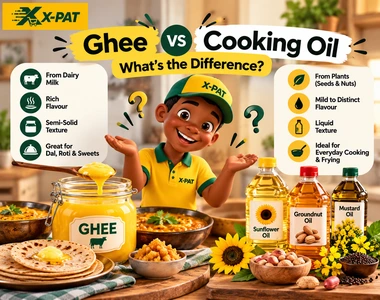
Ghee and cooking oil are both used to prepare food, but they differ in their source, flavour, fat composition and cooking applications. Ghee is a clarified dairy fat with a rich, buttery aroma, while cooking oils are generally extracted from plant sources such as sunflower, groundnut, mustard and soybean. The better choice depends on your recipe, nutritional needs and cooking habits.
For Indian families living in Ghana, both ghee and cooking oil can play useful roles in the kitchen. Ghee is often associated with dal, roti, paratha, khichdi and traditional sweets, while cooking oils are commonly used for sautéing, frying and preparing everyday vegetables.
Understanding the difference can help you choose the right ingredient without unnecessarily replacing one with the other.
What Is the Main Difference Between Ghee and Cooking Oil?
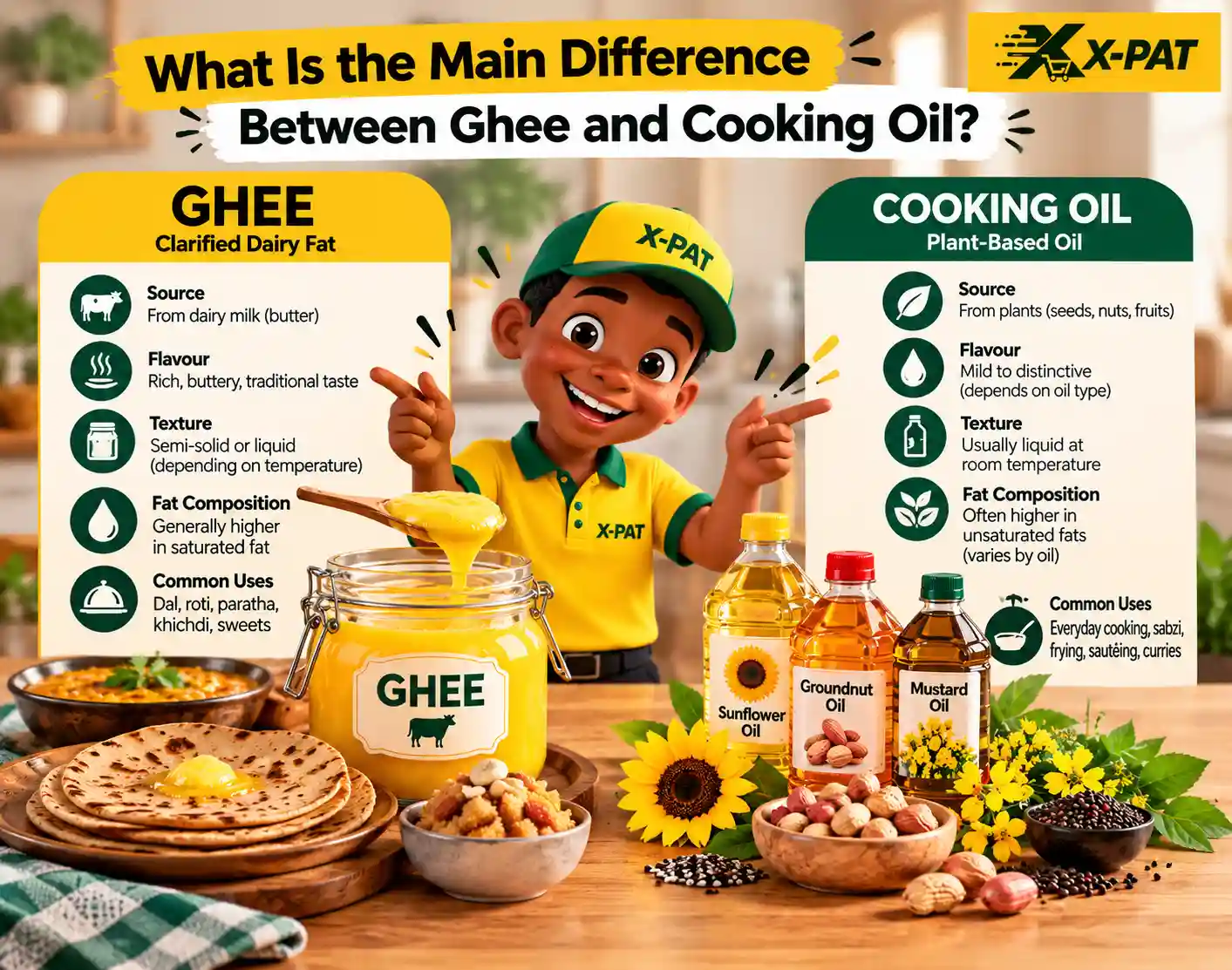
The biggest difference is how these two cooking fats are produced.
Ghee is prepared by heating butter to remove most of its water and separate the milk solids, leaving concentrated milk fat.
Cooking oil is generally obtained from plant sources such as seeds, nuts or fruits. Different oils have different fatty acid compositions, flavours and cooking characteristics.
Here is a simple comparison.
Feature | Ghee | Cooking Oil |
Source | Dairy fat | Usually plant-based |
Flavour | Rich, buttery, sometimes nutty | Mild to distinctive, depending on oil |
Texture | Liquid or semi-solid depending on temperature | Usually liquid at room temperature |
Saturated fat | Generally higher | Varies by oil |
Common uses | Dal, roti, paratha, sweets | Sabzi, frying, sautéing, curries |
Vegan-friendly | No | Most pure plant oils are |
Storage | Follow product instructions | Follow product instructions |
Both provide approximately 9 calories per gram because they are predominantly fat.
How Is Ghee Made Compared With Cooking Oil?
Ghee begins with butter, which is heated until most of the moisture evaporates and milk solids separate from the fat.
The resulting product has a concentrated flavour and is commonly used in Indian cooking.
Cooking oil is produced through processes that depend on the original ingredient.
For example, sunflower oil comes from sunflower seeds, groundnut oil comes from peanuts and mustard oil comes from mustard seeds.
Some oils are refined, while others are sold as cold-pressed or traditionally extracted varieties.
These production differences can affect flavour, aroma and cooking performance.
Is Ghee Healthier Than Cooking Oil?
There is no single answer because the nutritional quality depends on the specific cooking oil being compared with ghee.
Ghee generally contains a higher proportion of saturated fat. Many plant oils, including sunflower, soybean and groundnut oil, contain larger proportions of unsaturated fats.
Replacing saturated fats with unsaturated fats can help improve blood cholesterol levels, particularly LDL cholesterol, when the overall diet is otherwise balanced.
However, this does not mean ghee must be completely avoided.
Small amounts of ghee can fit into a balanced diet, depending on individual dietary needs and total saturated fat intake.
The important considerations are the quantity used, overall dietary pattern and the specific oil chosen.
What Are the Nutritional Differences Between Ghee and Cooking Oil?
Both ghee and cooking oil are energy-dense ingredients.
A tablespoon of either typically provides roughly 120 calories, although the exact amount depends on serving size and product composition.
Their main nutritional difference lies in the types of fat they contain.
Nutritional Factor | Ghee | Common Unsaturated Plant Oils |
Calories | High | High |
Total fat | Very high | Very high |
Saturated fat | Generally higher | Usually lower, depending on oil |
Unsaturated fat | Present | Often higher |
Cholesterol | Contains cholesterol | Naturally cholesterol-free |
Lactose | Usually very low, but not guaranteed absent | Naturally absent in pure plant oils |
People with milk allergies should not automatically assume ghee is safe, because residual milk proteins may remain.
For a more accurate comparison, always check the nutrition label on the particular product.
Which Is Better for Everyday Indian Cooking?
For most households, the practical answer is to use different fats according to the dish while keeping total fat consumption reasonable.
Cooking oil is often convenient for everyday preparations that require heating ingredients in a pan.
Ghee may be preferred when a rich aroma is part of the intended flavour.
For example, a household might use cooking oil for everyday sabzi and a small amount of ghee for dal tadka.
This approach allows families to enjoy traditional flavours without relying heavily on ghee for every recipe.
When Should You Use Ghee Instead of Cooking Oil?
Ghee is particularly useful when its flavour contributes to the finished dish.
1. Dal Tadka
A little ghee can be used to prepare a fragrant tempering with cumin, garlic or other spices.
2. Roti and Paratha
Some households spread a small amount of ghee over freshly cooked roti or use it while preparing paratha.
3. Khichdi
Ghee is a familiar finishing ingredient for khichdi and can add a richer flavour.
4. Indian Sweets
Recipes such as halwa, ladoo and certain traditional desserts often rely on ghee for their characteristic taste and texture.
In these dishes, ghee is not simply a substitute for oil; it contributes to the recipe’s identity.
When Is Cooking Oil a Better Choice?
Cooking oil is often more practical for recipes where a neutral or particular plant-based flavour is preferred.
Common applications include:
- Everyday vegetable sabzi
- Onion and tomato-based curries
- Sautéed vegetables
- Stir-fried dishes
- Pakora and other fried snacks
- Recipes requiring plant-based ingredients
Different oils produce different results.
For example, refined sunflower oil usually has a relatively mild flavour, while mustard oil has a distinctive pungency.
Groundnut oil may offer a different flavour profile and cooking performance.
The right choice depends on the recipe, the product’s heat suitability and household preferences.
Ghee vs Cooking Oil: Which Is Better for Frying?
Both can be used for certain frying applications, but suitability depends on the particular fat, its quality and the cooking temperature.
Ghee generally has a relatively high smoke point because most milk solids have been removed.
Many refined cooking oils also have smoke points suitable for frying.
However, smoke point is not the only consideration. Oil stability, heating duration and repeated use also matter.
Avoid overheating fats until they smoke, and do not repeatedly reuse frying oil that has deteriorated.
For deep-frying, choose an oil or fat appropriate for the temperature and cooking method rather than assuming all ghee or all cooking oils behave identically.
Can You Replace Ghee With Cooking Oil in Recipes?
Yes, in some recipes, but the result may not taste the same.
For example, cooking oil may work in a vegetable preparation that originally uses ghee.
However, replacing ghee in traditional sweets can change their aroma, texture and overall character.
Similarly, replacing a neutral oil with ghee may introduce a buttery flavour that is not intended.
Before making a substitution, consider whether the fat is being used mainly for cooking, texture or flavour.
For everyday dishes, substitution is often easier than in recipes where ghee is a defining ingredient.
Is Ghee Better Than Sunflower or Groundnut Oil?
These ingredients serve somewhat different purposes.
Sunflower oil is commonly used as an everyday cooking oil. Its fatty acid composition varies by product, including conventional and high-oleic varieties.
Groundnut oil is another option for cooking and may have a mild nutty character depending on processing.
Ghee offers a distinctive dairy-based flavour but typically contains more saturated fat than these unsaturated plant oils.
If your priority is reducing saturated fat intake, choosing an appropriate unsaturated plant oil more often may be beneficial.
If your priority is the traditional flavour of a particular dish, a modest amount of ghee may be useful.
There is no need to treat every cooking fat as interchangeable.
How Much Ghee or Cooking Oil Should You Use Daily?
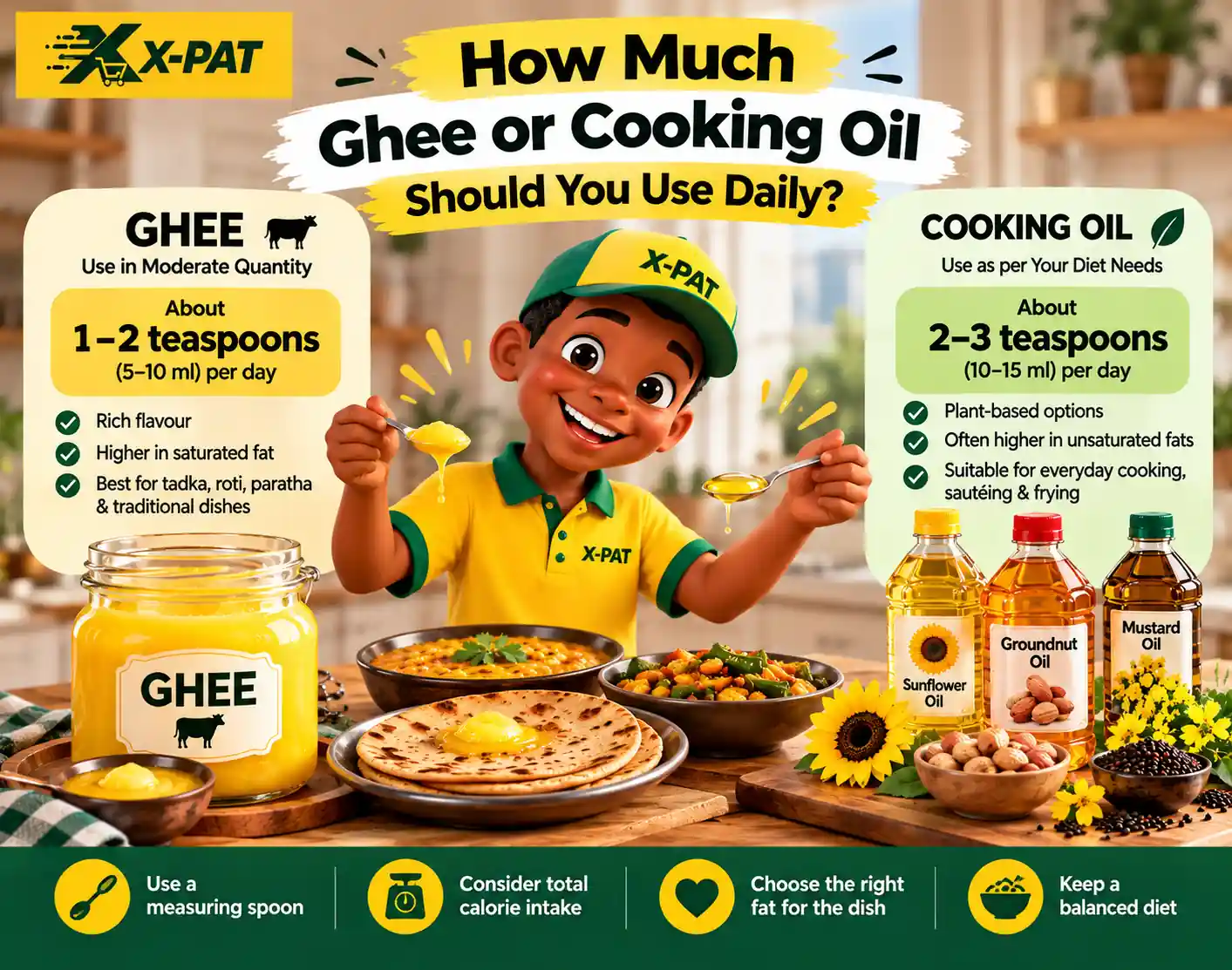
The appropriate amount depends on total calorie requirements, other foods consumed and individual health needs.
Rather than focusing only on the number of teaspoons of ghee or oil, consider all sources of fat in your diet, including nuts, seeds, dairy products, packaged snacks and fried foods.
Using a measuring spoon can help avoid adding more fat than intended.
For households trying to reduce saturated fat, it can also be helpful to use unsaturated plant oils more frequently and reserve ghee for dishes where its flavour matters.
People managing high cholesterol or cardiovascular conditions should follow advice suited to their individual health needs.
How Should You Store Ghee and Cooking Oil in Ghana?
Ghana’s warm climate makes correct storage particularly important.
Ghee can change between liquid and semi-solid consistency depending on temperature. This does not automatically mean it has spoiled.
Cooking oils can also deteriorate when exposed to excessive heat, light and air.
For both products, follow the manufacturer’s storage instructions.
Keep containers properly closed, avoid moisture contamination and store them away from direct sunlight and unnecessary heat.
Use a clean, dry spoon for ghee.
For cooking oil, avoid leaving bottles open for long periods or storing them immediately beside a hot stove.
If a product develops an unusual rancid smell or shows signs of deterioration, do not use it.
What Should You Check Before Buying Ghee or Cooking Oil Online in Ghana?
When shopping for ghee and cooking oil in Ghana, review the product information rather than choosing only from the picture.
Check the product type, ingredients, quantity, date information and storage directions.
For cooking oil, identify whether it is sunflower, groundnut, soybean, mustard or another variety.
For ghee, check the dairy source and any additional claims such as cow ghee or bilona ghee.
Choose a pack size according to how frequently you cook.
A small household may not need the same quantity as a family preparing several meals every day.
Always confirm current product availability before ordering.
How Can X-PAT Help You Plan Your Indian Cooking Essentials?
For Indian families and food lovers in Ghana, X-PAT provides a platform to explore Indian grocery and pantry products.
When planning your next grocery order, consider your complete cooking requirements.
If you regularly prepare dal, rice, roti and sabzi, your list may include atta, rice, pulses, spices, ghee and cooking oil.
For occasional traditional sweets, you may also need besan, sooji, sugar or other recipe ingredients.
Instead of buying cooking fats separately without a plan, build your grocery list around the meals your household actually prepares.
Check the current X-PAT catalogue for available ghee, cooking oils and other Indian pantry essentials.
Make Everyday Cooking Easier With the Right Choice
The choice between ghee and cooking oil is not about declaring one ingredient universally better than the other.
Ghee can bring a distinctive traditional flavour to dal, roti, paratha, khichdi and Indian sweets. Cooking oils offer different flavour profiles and are often practical for everyday curries, vegetables and frying.
For a balanced approach, choose suitable unsaturated cooking oils more often, use ghee in moderation when its flavour matters, and pay attention to your overall fat intake.
Explore ghee, cooking oils and everyday Indian grocery essentials with X-PAT in Ghana. Check the current catalogue, compare available products and plan your pantry around the meals you love to cook.
Frequently Asked Questions About Ghee vs Cooking Oil
What is the main difference between ghee and cooking oil?
Ghee is a dairy-based clarified butter fat, while most cooking oils are extracted from plants. They differ in flavour, fatty acid composition and common cooking uses.
Is ghee healthier than cooking oil?
Not necessarily. Ghee contains more saturated fat than many commonly used plant oils. Unsaturated oils are generally preferable when the goal is to reduce saturated fat intake.
Can I use ghee instead of cooking oil?
Yes, in many recipes. However, ghee adds a distinctive flavour and may change the final taste or texture.
Which is better for dal tadka?
Both can be used, but ghee is often preferred for its rich, buttery aroma.
Is ghee good for deep-frying? Ghee can be suitable for certain high-temperature cooking methods, but proper temperature control and avoiding overheating remain important.
Ghee can be suitable for certain high-temperature cooking methods, but proper temperature control and avoiding overheating remain important.